
Cold Plunge vs Ice Bath: What's the Difference?
One is a container of water and some ice. The other is a container of water with a refrigerator attached. The arithmetic below shows what that difference actually costs, in both directions, and where the cheaper option is the better one.

If you have spent an evening reading about cold water, you have probably noticed that two words get used as though they mean the same thing. They do not. An ice bath and a cold plunge produce a similar experience and almost nothing else in common: not the cost, not the effort, not the hygiene, and not the temperature you actually end up sitting in.
This guide explains the difference properly, with the arithmetic shown so you can check it. It is written for somebody considering spending several thousand pounds, which means it also covers the cases where the cheaper option is the better one.
The short answer
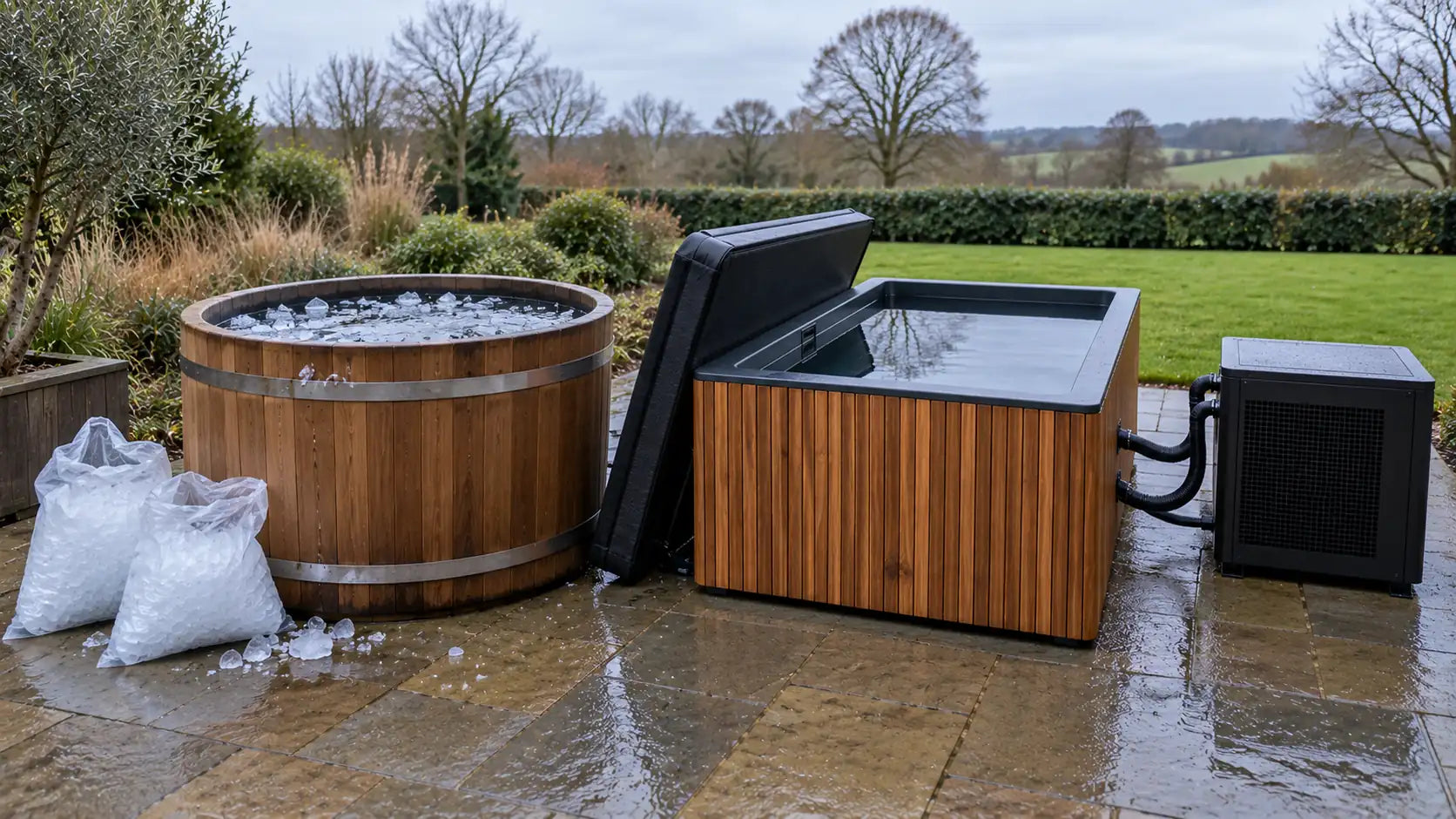
An ice bath is a container of water that you cool by adding ice. It has no moving parts. It costs very little to buy and something every single time you use it.
A cold plunge is a container of water with a refrigeration unit attached, usually called a chiller. It holds a temperature you set and keeps holding it. It costs a great deal to buy and very little to use.
Everything else in this guide follows from that one difference. An ice bath moves the cost into the future in small, repeated amounts. A cold plunge takes it all at the start.
What is an ice bath?
An ice bath is the older and simpler idea: a vessel, water, and enough ice to bring the water down to the temperature you want. The vessel can be a wheelie bin, a livestock trough, a purpose made insulated barrel, or a stock tank with a lid. Prices run from about thirty pounds to around a thousand for something well insulated and pleasant to look at.
There is no plumbing, no electrical supply, no filtration and nothing to service. That is the appeal, and it is a real one. It is also the whole design: an ice bath does nothing except hold water and keep it as cold as the ice you put in it.
Two consequences follow, and they are the two things people underestimate.
The first is that the temperature is never stable. Ice holds water near zero while it is melting, because melting absorbs heat without the temperature rising. The moment the last of it goes, the water starts warming towards the air temperature, and how quickly depends entirely on the insulation and the weather. A well insulated barrel with a lid on a February morning holds temperature for a long time. An uninsulated trough in an August garden does not.
The second is that you have to buy ice, every time, forever. That cost is worth doing properly, because almost nobody publishes it.
What is a cold plunge?
A cold plunge is the same vessel with a refrigeration circuit attached. A pump moves water past an evaporator, heat is carried away and rejected into the air outside, and a thermostat holds the water at whatever you have asked for. Most units on the UK market chill to around three degrees and many also heat, which turns the same tub into a warm bath in January.
Because the chiller runs on demand, the temperature is the same at seven in the morning as it was at seven the night before. You do not prepare anything. You take the cover off and get in.
The systems are more complicated in exactly the ways that matter later: there is a compressor, a pump, a filter and usually some form of sanitation. Each of those is a part that can need attention, and whether it can be attended to separately or only replaced as a unit is one of the most important questions you can ask before buying. We cover that in how to read a cold plunge specification.
Cold plunge versus ice bath, side by side
| Ice bath | Cold plunge | |
|---|---|---|
| Typical purchase price | £30 to £1,000 | £3,000 to £10,000 |
| Cost per use | The ice, every time | Electricity, measured in pence |
| Preparation before a session | Buy, carry and add ice | None. Remove the cover |
| Temperature control | Whatever the ice gives you | Set once, held automatically |
| Temperature stability | Falls, then rises as ice melts | Constant |
| Filtration and sanitation | None unless added | Usually built in |
| Water changes | Frequent | Infrequent |
| Electrical supply | Not required | Required, usually 13 amp outdoors |
| Parts that can fail | Effectively none | Compressor, pump, filter, controller |
| Suits a British winter | Very well. Cheap to run cold | Very well, and it also heats |
| Suits a British summer | Poorly. Ice costs multiply | Well, though the chiller works harder |
| Best suited to | Trying cold water, or occasional use | A daily habit, held at a set temperature |
What ice actually costs, with the working shown
This is the figure that decides the question for most people, and it is almost never published. So here it is, calculated from first principles. You can check every step.
The physics is settled and the numbers are standard. Water carries 4.18 kilojoules of heat per kilogram for every degree it changes. Melting ice absorbs 334 kilojoules per kilogram, which is where most of the cooling comes from. Ice out of a domestic freezer starts at about minus eighteen degrees, so it also absorbs a little heat warming up to zero before it melts.
Take a 700 litre tub, which is a common size for something you can lie down in, and a target of four degrees.
In summer, mains water in Britain arrives at roughly fifteen degrees. Cooling it to four means removing eleven degrees from around 626 litres of water, because the ice itself takes up the remaining volume. That comes to about 74 kilograms of ice.
In winter, the same mains water arrives at around eight degrees. Now you are only removing four degrees, and you need about 29 kilograms.
Bagged ice from a supermarket is £1.40 for two kilograms at Tesco and Sainsbury's at the time of writing, so seventy pence a kilogram. That makes one fill:
- Summer: about £52. Thirty seven bags.
- Winter: about £20. Fifteen bags.
A more useful way to hold the figure in your head: for a 700 litre tub, every single degree you want to remove costs about 7.5 kilograms of ice, or a little over £5. Halve the volume and you halve the cost.
Buying in bulk from an ice supplier rather than a supermarket brings the price down, and if you have a chest freezer you can make some of it yourself, which converts the cost into electricity and a lot of tray filling. Neither changes the shape of the problem. The ice bath's cost is a recurring one, it scales with how often you use it, and it is at its highest in the months when the water starts warmest.
The same cooling, done with electricity
Removing eleven degrees from 626 litres of water means removing about 8.9 kilowatt hours of heat. A refrigeration circuit does not manufacture cold, it moves heat from one place to another, which is why it needs less energy than the heat it shifts. Even on a pessimistic view of efficiency you would expect to use somewhere between three and four and a half kilowatt hours of electricity to do it.
At 26.32 pence per kilowatt hour, the Ofgem price cap for 1 October to 31 December 2026, that is between about 80 pence and £1.20.
So the same job that costs £52 in ice costs roughly a pound in electricity. That is not a marketing claim, it is arithmetic, and the ratio is somewhere around forty to one.
Two qualifications. First, that is the initial cool down only; holding temperature day after day uses more electricity, and the total depends on insulation, air temperature and how often the cover comes off. Second, you paid several thousand pounds for the machine doing it. The chiller wins comprehensively on cost per use and loses comprehensively on cost to acquire. Which matters more depends entirely on how often you are going to use it, which is the real question and we come back to it at the end.
If you want the running cost side in more detail, that is its own subject: what a cold plunge actually costs to run in the UK works the figures through at the current price cap, and how to read a cold plunge specification covers which consumption figures actually predict a bill and which are there to fill a table.
The temperature nobody mentions
Almost every product in this category advertises three degrees, and almost every buyer assumes that is the number to aim for. It is worth knowing what the research it is loosely based on actually used.
Reviews of post exercise cold water immersion describe the typical studied protocol as five to twenty minutes in water between roughly eight and fifteen degrees. That is meaningfully warmer than three, and it is the range in which most of the measured effects were observed.
This matters in two directions. If your interest is the evidence base, a tub that holds twelve degrees reliably is closer to the studied protocol than one that goes to three. And if your interest is the experience, three degrees is genuinely unpleasant for most people at first, and something unpleasant gets used less.
The practical consequence is that a chiller's real advantage is not how low it goes. It is that it holds whatever you choose, so you can start at fifteen and work down as you acclimatise, rather than making the same decision with a bag of ice every time.
What the research supports, and what it does not
Cold water immersion is better evidenced than most things sold under the heading of wellness, and less well evidenced than the marketing suggests. Two findings are worth knowing before you spend money.
For short term recovery, the evidence is reasonably good. Reviews report faster recovery of muscle strength, reduced muscle soreness and reduced perception of fatigue after immersion.
For building muscle, it may work against you. This is the finding that surprises people. Post exercise cold water immersion appears to attenuate the physiological adaptations to resistance training, apparently by blunting the anabolic signalling that follows a session. The same reviews note that this does not appear to apply to endurance training, where adaptations seem unaffected.
The practical reading is not that cold water is bad. It is that timing matters and that the goal changes the answer. If you are lifting to build muscle, immersing straight afterwards may be working against the session you have just done, and the cold is better placed on a rest day or well separated from training. If you are training endurance, or you simply want to feel better and sleep better, that concern does not appear to apply.
Nobody selling you a tub has an incentive to tell you this, which is precisely why it belongs in a buying guide.
The real ownership difference
The specification comparison above is the easy part. The differences that decide whether you are still using the thing in year three are less obvious.
Convenience, which is the one that actually predicts use
The single best predictor of whether cold water becomes a habit is how much stands between you and the water. An ice bath asks for a decision, a purchase, a car boot, a carry and a wait, before anything happens. A cold plunge asks you to lift a cover.
On a wet Tuesday in February, that difference is not a convenience feature. It is the difference between a habit and a piece of garden furniture. It is also the reason people who start with an ice bath and stick with cold water often end up buying a chiller: not because the ice bath stopped working, but because the friction quietly reduced how often they used it.
Temperature consistency
An ice bath gives you a curve. It is coldest shortly after the ice goes in, holds while the ice melts, then warms. If you want the same experience every day you have to keep adjusting the ice, and you are estimating rather than measuring.
A chiller gives you a number. That sounds like a small thing and it is not, for two reasons. Acclimatising sensibly means moving the temperature down deliberately over weeks, which is difficult to do by eye. And if you ever want to know whether cold water is doing anything for you, keeping one variable constant is the only way to find out.
Water quality and hygiene
This is where the two diverge more than most people expect, and the reason is temperature rather than equipment.
Health and Safety Executive guidance for cold water systems is to keep them, where possible, below twenty degrees. A plunge held at anything in its normal range sits a long way under that, and cold water is a considerably less hospitable environment than warm. An ice bath at four degrees is in the same position, while the ice lasts.
The difference is what happens in between. An ice bath left full in warm weather drifts upwards on its own, and with no filtration and no sanitation the water is doing nothing to look after itself. That is the case people get wrong: not the cold tub in January, but the full tub sitting at eighteen degrees in July with a cover on while nobody uses it.
A cold plunge normally has a filter and some form of sanitation running continuously, which is why water change intervals are measured in weeks or months rather than days. If you go the ice bath route, you will be draining and refilling it often, and a lid is not optional. Our guide to how often you should change cold plunge water sets out what the published commercial standard actually requires and what a sensible domestic routine looks like.
One point applies to both, and it is worth saying plainly: if the tub also heats, and you use it as a warm bath, none of the reassurance above applies. Warm water needs the discipline of a hot tub, not the discipline of a plunge.
Which suits the British climate better
Britain is the best possible argument for a chiller and the best possible argument against one, depending on the month.
From roughly November to March, an ice bath is close to free. Mains water arrives cold, ambient air keeps it cold, and on a hard frost you may not need ice at all. A chiller in the same months has very little work to do, and if it also heats, it becomes the more versatile object rather than the more expensive one.
From June to September the picture inverts. Mains water arrives warmer, air temperature works against you all day, and the ice requirement climbs to the seventy odd kilogram figure calculated above. A chiller works harder and uses more electricity, but more electricity here means pence rather than pounds.
The wet is a separate problem from the cold, and it applies to whatever you buy. Britain is mild and permanently damp rather than cold and dry, which is harder on timber, harder on fixings and harder on anything electrical sitting near the ground. That is a question about build quality rather than about cooling method, and it applies to a three hundred pound barrel and a seven thousand pound plunge alike.
Long term cost, over ten years
Neither option is cheap. They are expensive in different shapes, and the shape is what you should be choosing between.
An ice bath is cheap to acquire and its cost never stops. Three sessions a week, with the water and ice figures above, puts the annual ice bill in the hundreds of pounds even before you count the driving and the carrying. Over ten years that is a substantial number arriving in £1.40 instalments, which is exactly the shape of spending people underestimate.
A cold plunge is expensive to acquire and cheap to run, and its long term cost is dominated by something else entirely: whether it can be repaired. A sealed unit where a pump failure means replacing the whole machine has a very different ten year cost from one where a pump is a part. This is the question we would put to a manufacturer before anything else, and the answer is often harder to get than the price.
So the ten year comparison is not really ice against electricity. It is a predictable stream of small costs against a large cost plus a repairability risk. Reducing that risk is a matter of asking the right questions before you buy, not of paying more.
Why some people move from ice baths to cold plunges, and some go the other way
Both migrations happen and both are rational.
People move from ice to a chiller when the habit takes hold. Once you are in the water four or five times a week, the friction and the ice bill both stop being tolerable, and a machine that removes the preparation and reduces the cost per session to pence starts paying for itself in effort long before it pays for itself in money.
People move the other way when the habit does not take hold, or when it turns out they use it seasonally. Somebody who plunges twice a week between October and March, and hardly at all in summer, is close to the worst case for a chiller and close to the best case for a well insulated barrel. Buying the machine first, before knowing which of those you are, is the most expensive mistake available in this category.
Mistakes first time buyers make
- Buying for three degrees. Most people settle between eight and fifteen, which is also where most of the research sits. Chasing the lowest number on a specification tends to buy capability you will not use.
- Buying the chiller before the habit. Six weeks with a cheap insulated tub tells you how often you will actually get in. It is the least expensive market research available.
- Measuring the gate rather than the route. The commonest way a delivery of this size goes wrong is not damage, it is equipment that cannot reach the spot. Measure the narrowest point along the whole route, including the pinch three metres past the gate where the drainpipe is.
- Forgetting the ground. A 700 litre tub in use weighs close to a tonne. That needs a level, free draining, load bearing base laid and cured before delivery, not afterwards.
- Assuming the electrical supply is trivial. If there is no suitable outdoor socket already, running one is a new circuit, which is notifiable work under the building regulations in England and needs a registered electrician. Price it at the same time as the tub.
- Underestimating the summer ice bill. Winter ice costs are what convince people an ice bath is cheap. Summer is the real test.
- Leaving it full and switched off in warm weather. The riskiest state for the water is not cold, it is tepid and unattended.
Questions worth asking before you buy a cold plunge
If you have decided a chiller is right, these are the questions that separate products that look similar on paper. Ask them in writing.
- What is the measured electricity consumption across a week, in winter and in summer? Not the peak wattage.
- Who actually makes the chiller? Parts and servicing follow the maker rather than the badge.
- Can the pump be replaced on its own, or does a pump failure mean replacing the unit?
- Which spare parts are held in the UK, and what is the lead time on the ones that are not?
- What happens if the compressor fails in year four, and what does that cost?
- When does the warranty start, at delivery or at the invoice date, and what does it exclude?
- How long does it take to pull a full tub down to temperature, at two different air temperatures?
- How often does the water need changing with the filtration and sanitation running?
- Is delivery kerbside or positioned, and who moves it to the base?
A maker who answers all nine has thought about ownership. One who cannot answer several is not necessarily selling a bad product, but you are being asked to take on the uncertainty yourself.
Getting in safely
Worth a short section, because the risk is real and rarely mentioned by anyone selling a tub.
The RNLI defines anything below fifteen degrees as cold water, and describes what happens on sudden immersion: blood vessels constrict, heart rate and blood pressure rise, and the skin cooling causes an involuntary gasp, with breathing rate sometimes increasing as much as tenfold. Their advice for unexpected immersion is that the initial effects pass in less than a minute.
Applied to a garden tub, that translates into a few sensible habits. Get in slowly rather than jumping. Control your breathing before you go deeper than your chest. Do not go alone the first few times. Start warmer than you think you need to and work down over weeks. And if you have a heart condition, high blood pressure, or you are pregnant, this is a conversation to have with a doctor before you buy anything, not after.
Which one is right for you?
An ice bath is the better choice if you are new to cold water and want to find out whether you will stick with it. Or you expect to use it seasonally, mostly in the colder half of the year. Or there is no practical way to get a power supply to the spot. Or you would rather spend a hundred pounds finding out than five thousand assuming.
A cold plunge is the better choice if you already know you will use it several times a week, all year. Or you want the same temperature every session, either because you are acclimatising deliberately or because you want to know whether it is doing anything. Or the preparation is what has stopped you before. Or you want one object that is cold in summer and warm in winter.
Buy neither yet if you have not measured the route, the ground or the electrical supply. Those three decide whether either option is even possible where you live, and they are free to check.
If you are unsure which describes you, our seven question space check takes a few minutes and will tell you plainly when the answer is neither. The tubs Tarnfell lists, with the published figures those questions rest on, are in the cold plunge collection.
Final thoughts
A cold plunge does not do anything an ice bath cannot. It removes the work. Whether that is worth several thousand pounds depends entirely on how much the work has been costing you, in money and in sessions you did not bother with.
If you are still deciding whether cold water is for you, spend the smallest amount you can and find out. If you already know, and the preparation is the thing standing between you and using it, a chiller is the answer and the arithmetic supports it.
What we would not do is buy the expensive option to find out whether you want the cheap one.
Frequently asked questions
Is a cold plunge just an expensive ice bath?
Functionally, close to it. You are paying for the removal of preparation, a temperature you can set, and water that looks after itself between uses. Whether that is worth the money is a question about frequency rather than about the equipment.
How much ice does an ice bath need?
For a 700 litre tub taken to four degrees, roughly 74 kilograms in summer and 29 in winter, or about 7.5 kilograms for every degree you want to remove. At supermarket prices that is around £52 and £20 a fill respectively.
How long does an ice bath stay cold?
While the ice is melting the temperature is held near the bottom of its range, because melting absorbs heat without warming the water. Once the last of the ice has gone the water climbs towards the air temperature, and how fast depends on insulation, whether there is a lid, and the weather. That is genuinely variable, and a single figure for it would be invented rather than measured.
What temperature should a cold plunge be set to?
Most people settle between eight and fifteen degrees, which is also where the studied protocols sit. Three degrees is available on most machines and used regularly by fewer people than buy it.
Is one easier to keep clean?
A cold plunge, comfortably, because filtration and sanitation run continuously and water change intervals stretch to weeks or months. An ice bath has no such help and needs draining and refilling far more often.
Do cold plunges use a lot of electricity?
Cooling itself is inexpensive; the initial pull down of a 700 litre tub costs roughly a pound. Holding temperature over a year is the larger figure and it depends on insulation, air temperature and use. Any maker who cannot give you measured weekly consumption in both summer and winter is asking you to guess.
Which is better for a British garden?
Both work here. An ice bath is at its best from November to March and at its worst in high summer. A cold plunge is consistent year round and, if it also heats, more useful in winter than in summer. The damp is a harder test than the cold for either, and that is a question about build quality.
Do I need planning permission or an electrician?
Planning permission is usually not required for equipment of this kind in a garden, though a listed building or a conservation area changes the answer. Electricity is the part that catches people: if there is no suitable outdoor socket, installing one is a new circuit and therefore notifiable work under the building regulations in England, which means a registered electrician and a certificate.
Can I make my own ice to save money?
Partly. A chest freezer converts the cost into electricity and a great deal of tray filling, and domestic freezers make ice slowly. It reduces the bill rather than removing it, and it adds a job.
Will cold water help me build muscle?
Probably not, and it may work against it. Cold water immersion straight after resistance training appears to attenuate the adaptations that session was meant to produce, while the same effect does not appear with endurance training. Short term recovery of strength and soreness does improve. If muscle growth is the goal, separate the cold from the lifting.
Where the figures in this article come from
Every number above is either calculated from standard physical constants, with the working shown, or taken from a published source. In order of appearance:
- Specific heat capacity of water, latent heat of fusion of ice and specific heat of ice are standard values: 4.18, 334 and 2.05 kilojoules per kilogram respectively.
- Bagged ice price: The Ice Co. 2kg, £1.40 at Tesco and Sainsbury's, checked at the time of writing.
- Electricity price: 26.32 pence per kilowatt hour, the Ofgem price cap for 1 October to 31 December 2026, read 1 October 2026. No VAT is charged on household electricity under the cap between 1 October 2026 and 31 March 2027.
- Cold water immersion protocols and training adaptations: Frontiers in Sports and Active Living, 2021.
- Cold water temperature guidance: Health and Safety Executive.
- Cold water shock: RNLI.
- Notifiable electrical work: Approved Document P.


