
What a cold plunge actually costs to run in the UK
At the current price cap, a chiller takes a 700 litre tub to 4°C for roughly 80p to £1.20. Bagged ice does the same job for about £52. The working, shown in full.

The short version: at the current electricity price cap, taking a 700 litre tub from summer tap water down to 4°C costs roughly 80p to £1.20 through a chiller. Doing the same job with bagged supermarket ice costs about £52. Every figure below comes with its working, so you can check the arithmetic rather than take our word for it.
Where the money actually goes
A powered cold plunge has three running costs: electricity for the refrigeration circuit and circulation pump, water when you drain and refill, and consumables such as filter cartridges. Electricity dominates, so that is where this guide spends its time. Water and filter costs vary by supplier and product, and they are worth checking, but they will not change the shape of the answer.
The electricity price this guide uses
All arithmetic below uses the Ofgem price cap for 1 October to 31 December 2026: 26.32p per kWh, the Direct Debit average for England, Scotland and Wales, with no VAT on household electricity from 1 October 2026 to 31 March 2027. The cap changes again on 1 January 2027, so if you are reading after that date, rerun the sums with the current figure. The method does not change. We exclude the daily standing charge because you pay that whether or not you own a plunge.
Cooling the water down: the working
Cooling water is physics before it is a product, which means you can check every number in this section.
Take a 700 litre tub filled from the mains in summer at about 15°C, with a target of 4°C. Removing heat from water takes 4.18 kilojoules per kilogram per degree, so the total heat to remove is:
700 kg × 4.18 kJ × 11 degrees ≈ 32,200 kJ, which is 8.9 kWh of heat.
A chiller does not consume 8.9 kWh of electricity to do this, because a refrigeration circuit moves heat rather than generating cold. Small chillers typically move two to three units of heat per unit of electricity they draw, so removing 8.9 kWh of heat takes roughly 3 to 4.5 kWh at the socket:
3 to 4.5 kWh × 26.32p = 79p to £1.18 for the full pull-down.
A smaller tub scales down in proportion. A 300 litre plunge is the same sum with 300 in place of 700: roughly 34p to 51p.
The same job done with bagged ice
One kilogram of ice from a domestic freezer at −18°C absorbs about 387 kilojoules on its way to becoming 4°C water: warming the ice, melting it (the largest term, 334 kJ), then warming the meltwater. So the summer pull-down above needs:
32,200 ÷ 387 ≈ 74 kg of ice.
At the time of writing, The Ice Co's 2 kg bag sells for £1.40 at Tesco and Sainsbury's (checked 30 July 2026), which is 70p a kilogram. Seventy-four kilograms is about £52, for one summer cool-down that a chiller does for around a pound.
From winter mains at about 8°C the ice requirement falls to roughly 29 kg, about £20. Either way, per unit of heat removed, the ratio sits near forty to one in the chiller's favour.
| Method | Summer pull-down, 700 L to 4°C | Winter pull-down, 700 L to 4°C |
|---|---|---|
| Chiller, at the current cap | 79p to £1.18 | Around 30p to 45p |
| Bagged supermarket ice | About £52 (74 kg) | About £20 (29 kg) |
| Winter mains water alone | Not applicable | Free, and already about 8°C |
Holding temperature after the pull-down
Once the water is cold, the chiller only runs to offset heat leaking back in, and how much that is depends on insulation, whether a fitted cover is on, the weather, and how often you get in. We have not found a UK manufacturer that publishes measured duty-cycle data, so we are not going to invent a daily figure here.
What the arithmetic above does give you is a ceiling. Even if your tub needed a complete pull-down from scratch every single day, that is under £1.20 a day at the current cap, or about £36 a month. An insulated tub with its cover on, holding a steady temperature, costs less than that. When you compare products, ask for the chiller's rated cooling capacity in kilowatts and its power draw in watts; those are the two numbers that matter, and our guide to reading a cold plunge specification shows what to do with them.
The fact that might save you the whole cost
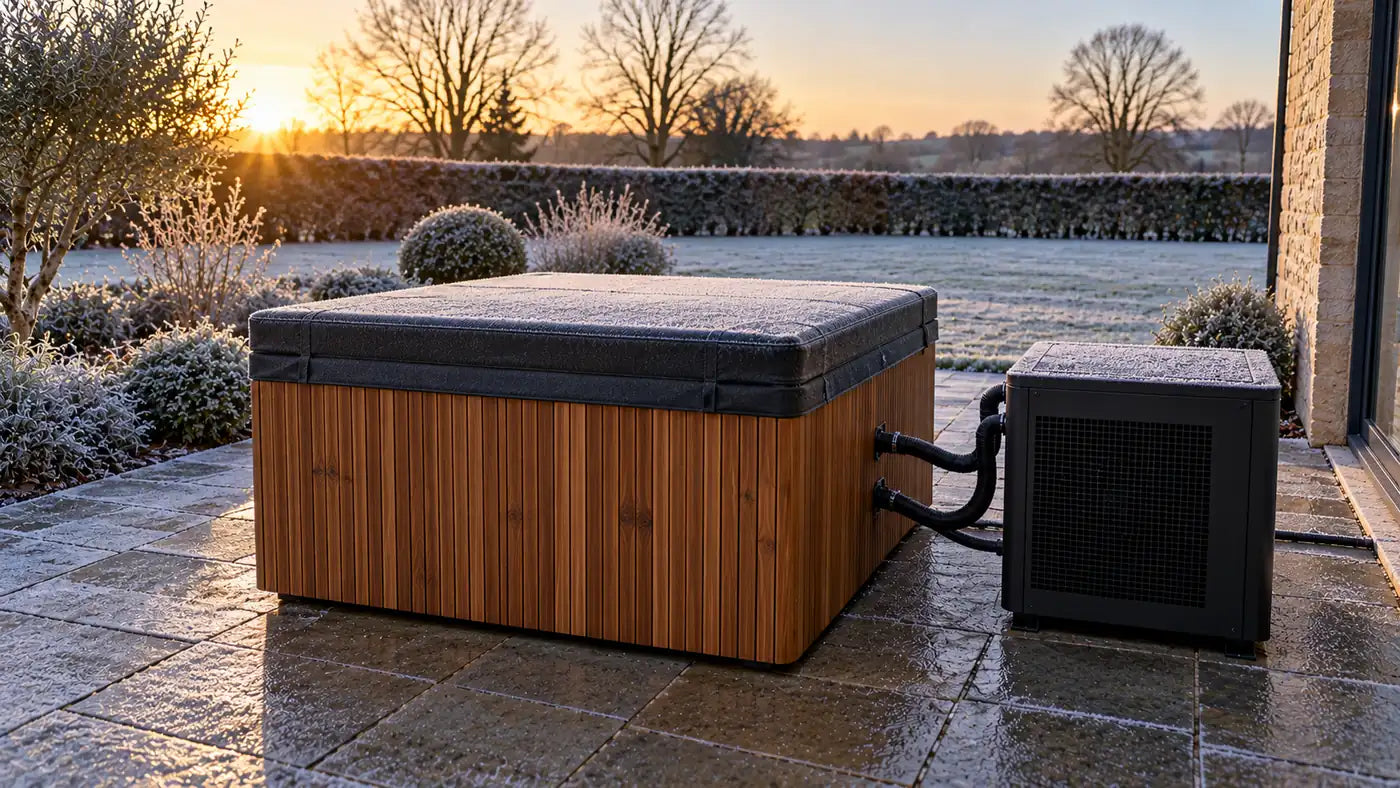
The research on cold water immersion describes protocols of five to twenty minutes in water at roughly 8 to 15°C (Frontiers in Sports and Active Living, 2021). UK mains water in winter arrives at around 8°C. From roughly November to March, a tub filled fresh from the tap is already inside the studied temperature range with no chiller running at all.
What a chiller actually buys you is consistency, and the other seven months of the year. If cold plunging is a winter habit for you, you may not need one. Our guide to using a cold plunge in winter takes that further, including the air temperature at which Chill Tubs tell owners to fully drain the tub. If you want a held temperature year round, the running cost of that is the figure this guide exists to show you, and the difference between chilled and ice-filled tubs is covered in our guide to cold plunges versus ice baths.
Before you buy
If you are working out whether a plunge fits your garden, water supply and electrics in the first place, start with Plan your space. The tubs we are evaluating are listed under cold plunge baths.
Sources and assumptions
- Electricity price: Ofgem price cap unit rates, 26.32p per kWh, Direct Debit average for England, Scotland and Wales, 1 October to 31 December 2026, with no VAT on household electricity in that period. ofgem.gov.uk
- Ice price: The Ice Co 2 kg at £1.40 in Tesco and Sainsbury's, checked 30 July 2026 via Trolley.co.uk price tracking. Supermarket prices move; treat 70p a kilogram as indicative.
- Physical constants: specific heat of water 4.18 kJ/kg·K, latent heat of fusion of ice 334 kJ/kg, specific heat of ice 2.05 kJ/kg·K, domestic freezer at −18°C. Standard values, not vendor figures.
- Cold water immersion protocols: five to twenty minutes at approximately 8 to 15°C. Frontiers in Sports and Active Living, 2021. frontiersin.org
- Chiller efficiency: stated as a range of two to three units of heat moved per unit of electricity, which is typical for small refrigeration circuits. Where a manufacturer publishes measured figures, those take precedence.


