
Do you need an electrician for a cold plunge?
A plunge chiller draws about 1.5 to 4.5 amps, so an RCD protected outdoor socket is usually all it needs. What the wiring standard requires, and when a new circuit becomes notifiable under Part P in England.

Usually not, and it is worth knowing why before anyone quotes for work you may not need. A cold plunge chiller draws between about 1.5 and 4.5 amps at 230 volts, well inside the 13 amps an ordinary UK outdoor socket supplies, so if you already have a suitable RCD protected outdoor socket you plug in and that is the end of it. An electrician enters the picture when the socket does not exist yet: installing a new outdoor circuit is notifiable work under Part P of the Building Regulations in England, and using a registered electrician is the route that ends with certificates rather than with a problem when you sell the house.
How much power does a cold plunge actually draw?
Less than most people assume, because a chiller is a refrigeration circuit, and refrigeration moves heat rather than generating cold. The electrical input is a fraction of the cooling delivered. The TECO TK 2000, one of the few chillers whose manufacturer publishes full electrical data, consumes 350 watts at 230 volts, which works out at 350 ÷ 230 = about 1.5 amps, with a coefficient of performance of 2.49, so those 350 watts of electricity remove roughly 870 watts of heat from the water. Purpose-built plunges with larger chillers, filtration and heaters draw more, but plunges sold for UK gardens are designed around the standard BS 1363 13 amp plug, which supplies about 230 × 13 = 2,990 watts, call it 3 kilowatts. The rated power is on the specification sheet, and our guide to reading a cold plunge specification shows where to find it and what to check it against.
The contrast with a sauna shows why the plunge gets off lightly. A 6 kW electric sauna heater at 230 volts draws about 6,000 ÷ 230 = 26 amps, twice what a 13 amp plug can carry, which is why a sauna heater is hard-wired on its own dedicated circuit and a plunge is not. If you are weighing up both, our comparison of wood fired and electric saunas covers what that circuit involves.
Can you run a cold plunge from an existing outdoor socket?
Yes, provided the socket is protected by an RCD, a residual current device that cuts the power in a fraction of a second if current leaks to earth. Electrical Safety First, the UK consumer charity for electrical safety, puts it plainly: "Use a residual current device (RCD) with all outdoor electrical equipment." Its guidance on mains supplied outdoor water pumps, the closest published analogue to a plunge chiller, adds that the RCD should be tested at least every three months, which you do by pressing the test button and confirming the power trips off.
Extension leads deserve their own paragraph, because a plunge is a permanent installation and a lead is not. Electrical Safety First's conditions for outdoor use are specific: leads and reels must be suitable for outdoor use, weather resistant with moulded connections to keep moisture out, rated correctly for the connected load, and cable reels must be fully unwound before use because a coiled cable under load heats up. A lead that meets every one of those conditions is still a temporary arrangement trailing across a garden in all weathers, and a plunge bought for year round use is one you will want to use through a British winter rather than unplug in October. If the tub is staying, the socket should live where the tub lives.
What RCD protection does the wiring standard require?
The national wiring standard, BS 7671, requires in regulation 411.3.3 that socket-outlets rated up to 32 amps have RCD protection with a rated residual operating current not exceeding 30 milliamps, and applies the same 30 mA requirement to mobile equipment rated up to 32 amps for use outdoors. That is published by the Institution of Engineering and Technology, which co-publishes the standard itself, so it is the rule from the rule maker rather than a retailer's paraphrase.
One timing point if you are collecting quotes this autumn. BS 7671 is amended rather than reissued, so the edition named on a certificate changes over time. The IET and BSI published Amendment 4 on 15 April 2026, and the previous version, BS 7671:2018+A2:2022+A3:2024, is withdrawn on 15 October 2026. An electrician may work to either until that date, so a certificate issued this autumn can legitimately cite either edition.
The practical consequence: any socket installed to current standards already meets the requirement, but a socket installed decades ago may predate it. If pressing the test button does nothing, or there is no test button anywhere between the socket and the consumer unit, have an electrician look before the tub arrives. Adding RCD protection to an existing socket is a small job compared with running a new circuit.
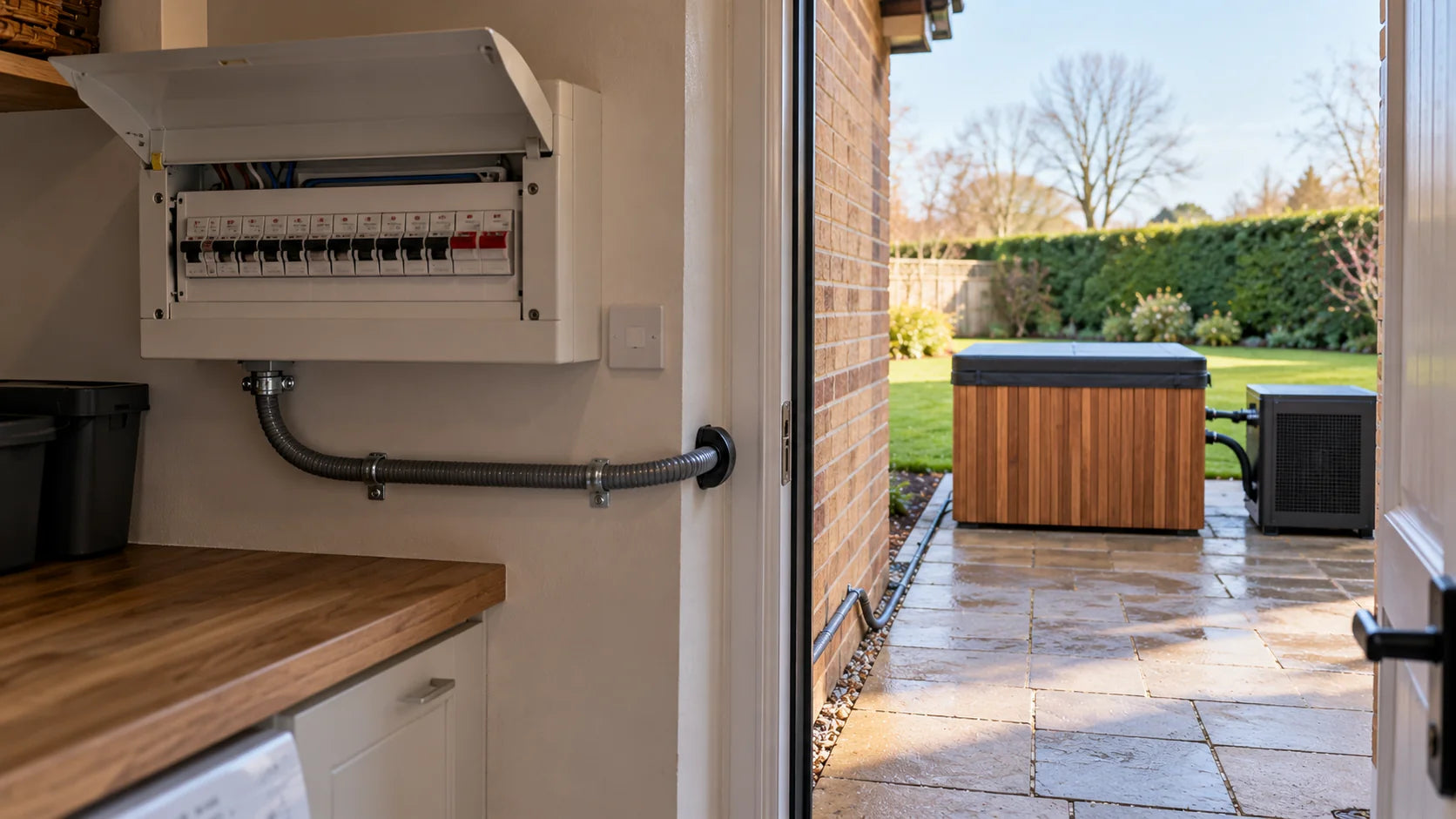
When does the work become notifiable under Part P?
Part P of the Building Regulations covers electrical safety in dwellings in England, and its scope explicitly includes gardens: Approved Document P, 2013 edition, applies to installations "outside the dwelling", giving fixed lighting and pond pumps in gardens as its own examples, and to outbuildings such as sheds and detached garages that share the house's electricity. Wales has had its own diverging rules since 31 July 2014, so everything here is England unless stated.
Under regulation 12(6A), exactly three kinds of work are notifiable to building control: the installation of a new circuit, the replacement of a consumer unit, and any addition or alteration to existing circuits in a special location. Everything else must still comply with BS 7671, but does not need notifying. Applied to a cold plunge:
| Work | Notifiable in England? |
|---|---|
| Plugging the plunge into an existing outdoor socket | No. This is not installation work at all. |
| Adding an outdoor socket as a spur from an existing circuit | No, but it must comply with BS 7671, including 30 mA RCD protection. |
| Installing a new circuit for an outdoor socket | Yes. |
| Replacing the consumer unit to make room for the new circuit | Yes. |
| Any addition or alteration to circuits in a room containing a swimming pool or sauna heater | Yes. |
The last row needs reading carefully, because it is where plunges and saunas part company. Approved Document P defines the special location as "a room containing a swimming pool or sauna heater". A plunge tub standing in the open garden is not in a room, so the special location trigger rarely applies to it, and the question is simply whether a new circuit is being installed. A sauna is the opposite case: the room containing the heater is itself a special location, so even minor additions to existing wiring in that room are notifiable.
What paperwork should you get?
An electrician registered with a competent person scheme self-certifies the work and issues two documents: an Electrical Installation Certificate or Minor Works Certificate confirming the work meets BS 7671, and a Building Regulations Compliance Certificate confirming it meets the Building Regulations. The alternative to having them is stated bluntly by Electrical Safety First: homeowners and landlords "must be able to prove that all electrical installation work meets Part P, or they will be committing a criminal offence", and local authorities can make homeowners remove or alter work that does not comply. Conveyancing solicitors ask for these certificates when a house is sold, which is when missing paperwork stops being theoretical. File them with the boiler service records and forget about them.
So do you need an electrician at all?
Here is the accounting, including the parts that earn nobody any money. If your garden already has an RCD protected outdoor socket within reach of where the tub will sit, you need no electrician, no new equipment and no paperwork: the installation is a plug going into a socket. If a socket can be added as a spur from an existing circuit, the job is small and not notifiable, though it still needs doing to BS 7671 and is not sensible DIY next to several hundred litres of water. Only when a new circuit is needed, or the consumer unit has to change to accommodate one, does the full notifiable route apply, and then the registered electrician route typically costs less than a building control application for DIY work, and comes with the certificates.
One planning point worth settling before anyone quotes: decide where the tub actually goes first, because the socket should be positioned for the tub rather than the other way round. Plan your space works through siting, and the electrics are only one line in the running picture: what a cold plunge actually costs to run in the UK puts the chiller's consumption in pounds, and each listing in our cold plunge collection states the electrical requirement rather than leaving you to guess it.
Sources
- Approved Document P: electrical safety, dwellings, 2013 edition (GOV.UK), including regulation 12(6A) on notifiable work, the definition of special locations, and the scope covering gardens and outbuildings.
- IET Wiring Matters, July 2022: socket-outlets and 30 mA RCD protection, on regulation 411.3.3 of BS 7671.
- IET and BSI: Amendment 4 (2026) to BS 7671:2018, published 15 April 2026, which states that the previous version is withdrawn six months from that date. Read 1 October 2026.
- IET: Part P, England and Wales, on notifiable work and the 2014 divergence of the Welsh regulations.
- Electrical Safety First: Part P of the Building Regulations, on certificates and the consequences of non-compliance.
- Electrical Safety First: garden safety, on RCDs, testing and outdoor extension leads.
- TECO TK 2000 technical data (TECO EU), 350 W power consumption at 230 V/50 Hz, COP 2.49.


