
Does a sauna need ventilation?
Harvia publish six air changes an hour, a 50 to 100mm supply vent and an exhaust pipe twice that diameter. Most of that is designed into a finished cabin, so the useful question is what is left for you to arrange: the room for an indoor cabin, and chimney fitting on a wood burner.

Yes, and the published specification is more precise than most buyers expect. Harvia, whose technical documentation covers a good part of the range Tarnfell sells, state that the air in a sauna should change six times an hour, that the supply air pipe should be 50 to 100mm in diameter, and that the exhaust pipe should be twice that. The more useful question is who has to satisfy it. Nearly all of that guidance is written for somebody building a sauna room from scratch, and if you are buying a finished cabin the manufacturer has already answered most of it. What is left for you is short, and it is worth knowing before you order rather than afterwards.
What does the published guidance actually require?
Harvia publishes the same figures in two places, its installation and planning instructions and its own support documentation, and the two agree. The headline requirement is a rate rather than a vent size: the air in the sauna should change six times an hour. Everything else follows from delivering that without disturbing the way the room heats.
| What | Harvia's published figure |
|---|---|
| Air exchange rate | Six air changes an hour |
| Supply air pipe diameter | 50 to 100mm |
| Exhaust air pipe diameter | Twice the diameter of the supply pipe |
| Exhaust vent position | Near the floor, as far from the heater as possible |
| Supply vent position, gravity exhaust | Below or next to the heater |
| Supply vent position, mechanical exhaust | Above the heater, in the upper part of the room |
| Door gap where the exhaust vent is in an adjoining washroom | At least 100mm |
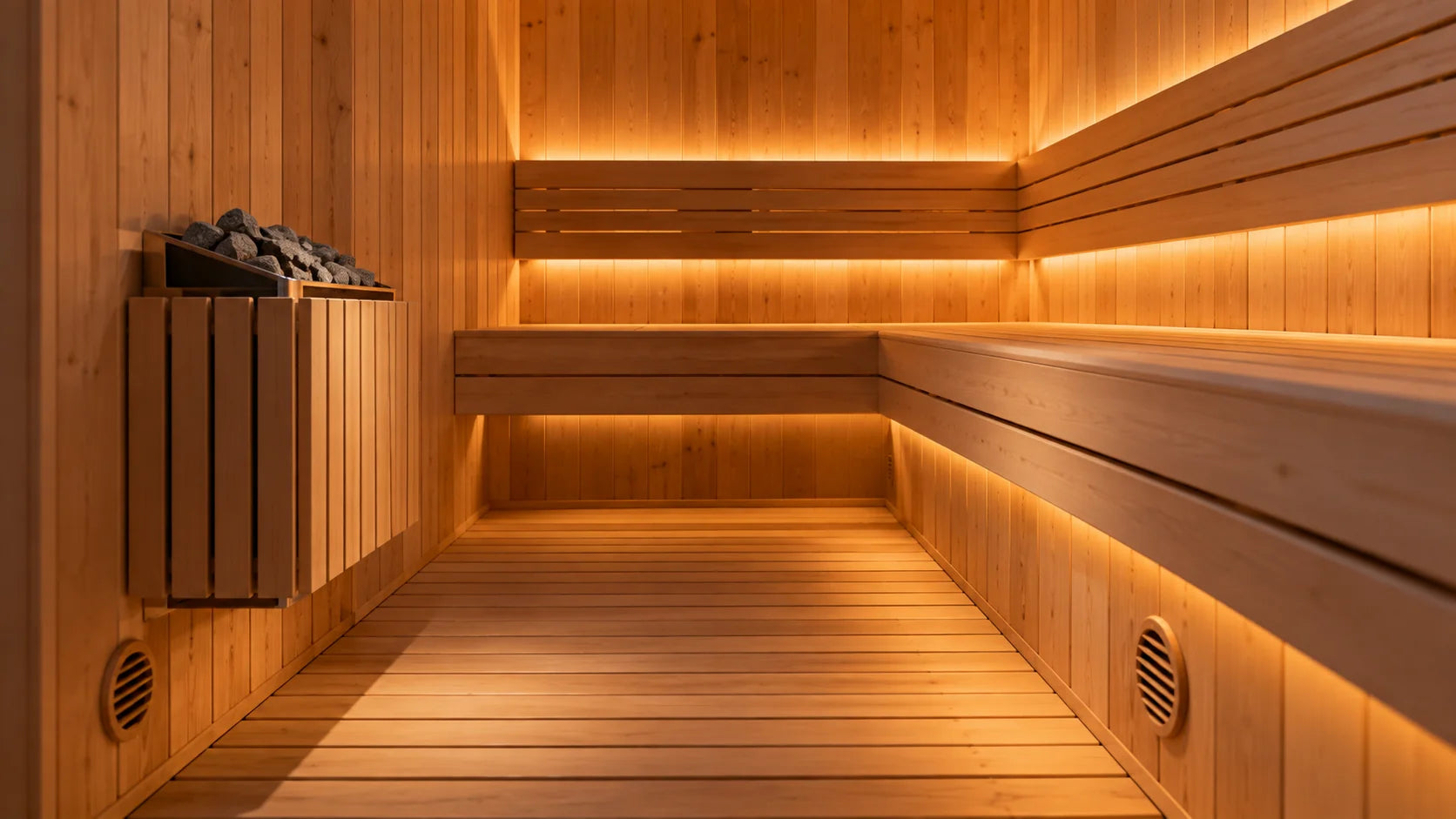
Two things in that table are worth pausing on, because they are where sauna ventilation stops behaving like ordinary room ventilation. The exhaust is larger than the inlet, which is the opposite of what most people assume, and the exhaust sits low rather than high even though hot air rises. Both serve the same purpose: air is drawn in near the heat, pushed up and across the bathers, and pulled out at floor level once it has given up its heat, so the room is swept rather than simply topped up.
Why does the position of the inlet depend on how the air leaves?
This is the part that catches people who have read an American self build guide and assumed it transfers. Harvia's placement rule for the supply vent reverses depending on the exhaust: with gravity exhaust the supply vent goes below or next to the heater, and with mechanical exhaust it goes above it. The same cabin, ventilated two different ways, wants its inlet in two different places.
There is a practical consequence that matters more than the geometry. Harvia's instructions for heaters with a separate temperature sensor add a warning: do not place the supply air vent so that the airflow cools the temperature sensor. A cold draught playing across the sensor makes the heater read the room as cooler than it is, so it keeps calling for heat. The room then runs hotter than the dial says, and the electricity bill follows it. That is an argument for not moving an inlet around after installation on the reasoning that more air must be better, and it is the sort of detail that only shows up in the manufacturer's own documentation. Our guide to sauna heater sizing covers the other half of that relationship, which is how the room's construction changes the heater the cabin needs in the first place.
How much of this is your job if you are buying a finished cabin?
Much less than the guidance implies, and this is the distinction that most sauna ventilation advice online does not draw. Harvia's figures are design figures. They are written for the person deciding where to cut a hole, which is the self builder or the installer fitting out a room. A finished cabin arrives with its ventilation provision designed in alongside the heater, because the manufacturer sized one against the other.
Tarnfell's own listings show that directly in one case. The Harvia Panorama states that the floor grid, heater guard, ventilation slit and silicone cables are included in the price, so the cabin's own air path is part of what is supplied rather than something to add. Most cabin listings do not itemise ventilation separately, which is why the sensible move is to ask rather than assume.
Three questions cover it, and all three are answerable before you order:
- Does the cabin have its own supply and exhaust provision, or does it rely on the room it stands in? This is the question that separates a self contained outdoor cabin from an indoor fit out.
- If it relies on the room, what does the room need to provide? An indoor cabin makes the room part of the installation, and the floor area, finished height and assembly clearance come into it as well. Our guide to how much space an indoor sauna needs sets those out across the indoor range.
- Is the exhaust mechanical or gravity? It decides where the inlet belongs. Harvia's guidance states that where the exhaust vent is in an adjoining washroom the gap under the sauna door must be at least 100mm, and states separately that mechanical exhaust ventilation is mandatory, without tying that second sentence to a particular case. Put it to whoever specifies the installation rather than reading it either way.
What changes with a wood burning heater?
Two things, and the second is the one that costs money. Harvia's vent placement for a wood burning heater differs from the electric case: with gravity ventilation the fresh air inlet goes near the floor beside the stove and the outlet far away and near the roof, and with mechanical ventilation the inlet goes roughly 500mm above the stove with the outlet near the floor beneath the benches. A stove also has to draw combustion air, which an electric element does not, so the inlet is feeding the fire as well as the bathers.
The second thing is the flue. Tarnfell's two wood burning options, the Harvia Kuusi 180 Panorama and the Harvia Kaski 180 Panorama, both come with the Harvia Linear 18, which Harvia rate for rooms of 5 to 18 cubic metres and supply with its steel chimney kit for barrel saunas, protective bedding and 40kg of stones. The kit is in the price; fitting it is not. The Kuusi listing says so plainly, that the base, the electrical work or chimney fitting, and the build are yours to arrange. A wood fired barrel therefore has a trade to book that an electric one does not, and it is worth pricing that before choosing the heater rather than after the pallet lands.
What does poor ventilation actually cost you?
It shows up in the timber rather than in the session. A sauna that cannot clear its moisture stays damp between uses, and damp timber is what shortens a cabin's life. Harvia's own guidance offers the simplest remedy alongside the vents: the sauna can also be dried by leaving the door open after bathing, and its instructions treat a separate drying vent as optional, closed during heating and bathing, for exactly that job.
That is one habit rather than a maintenance programme, and it costs nothing. It is also the point where ventilation stops being a specification and becomes ownership: the cabins in the range that say anything at all about drying say it for the same reason. The Kuusi listing states that the cabin should be dried out by heating it after wet weather, and that the timber under the glass can mark with condensation. Our guide to how much maintenance an outdoor sauna needs puts that alongside the rest of the annual list.
What this means when choosing
Ventilation is not a reason to choose one cabin over another, and treating it as a comparison column would be inventing a difference. What it is, is a short set of questions that tells you whether a cabin is a finished unit or a kit of parts that assumes a room around it, and that distinction does change what you are buying.
If the sauna is going outdoors and arrives as a complete cabin, the ventilation question is largely answered for you and the work in front of you is the base, the supply and, on a wood burner, the flue. If it is going indoors, the room becomes part of the installation and the ventilation route out of it is worth settling with whoever is fitting it, before the cabin is ordered rather than after. And if you are weighing a wood burner, add chimney fitting to the quote list on day one.
If you are still working through the decisions in order rather than the details, our outdoor sauna buying guide takes the five that come before this one.
Sources
- Harvia. Ventilation in the sauna, on the six air changes an hour, supply and exhaust pipe diameters, vent placement for electric and wood burning heaters, the 100mm door gap, the statement that mechanical exhaust ventilation is mandatory, and drying the sauna by leaving the door open. Read 1 October 2026.
- Harvia. Instructions for planning and installation, which publishes the same air exchange rate, pipe diameters and placement rules, the warning not to let the supply airflow cool the temperature sensor, and the optional drying vent. Read 1 October 2026.
- Tarnfell product listings for the Harvia Panorama, on the included ventilation slit, and the Harvia Kuusi 180 Panorama, on the Harvia Linear 18 chimney kit, what the price includes and what the buyer arranges. Specifications and prices read 1 October 2026.


