
The outdoor sauna buying guide: five decisions before you spend
Buying an outdoor sauna is about more than choosing a shape. This guide covers five decisions that matter before you spend: format, size, heating, base and garden siting.

An outdoor sauna comes down to five decisions: the format, the size, what heats it, what it stands on, and where in the garden it can legally go.
Everything else is finish and colour.
This guide takes those decisions in the order they need to be made, because getting the first one wrong can make every decision after it more expensive.
1. Barrel or cabin: what are you actually choosing between?
Tarnfell's outdoor range comes in two shapes: nine barrels and eight rectangular cabins.
A barrel is a cylinder of solid timber staves, and most of them put two benches facing each other across the floor. A rectangular cabin has square or oblong walls, most with a glazed front or a glazed door, and a rectangle makes it straightforward to stack benches at two heights so people can choose how hot they sit.
That is more than an aesthetic difference. You are choosing between different internal geometry, footprints, seating arrangements and ways of using the space.
| Barrel | Rectangular cabin | |
|---|---|---|
| Room shape | Circular | Square or oblong |
| In the range now | Nine | Eight |
| Bench layout | Commonly two facing benches | Along a wall, often at two heights |
| Dedicated circuit stated on the pages | 35 to 50 amps, eight of the nine on 40 or 50 | 20 to 35 amps |
| Price range | £6,195 to £10,995 | £3,495 to £10,095 |
The last two rows are where that table earns its place. Above about £6,195 the two shapes overlap almost completely, so shape is not a budget decision; below it there are four cabins and no barrels at all, so the choice is made for you. And the circuit split is the pattern most buyers do not expect: it is the heaters the makers have chosen to fit rather than anything about shape, but it is real in what you can buy today, and if your electrical supply is tight it points at a cabin. Circuits were read from the product pages on 25 September 2026 and prices on 13 October 2026, and both move, so use the live outdoor sauna collection for the current position.
The Harvia Kuusi 180 Panorama is a 40mm solid spruce barrel with four seats and an 8kW heater included. The Holl's Onyxia Cube is a four person cabin in 40mm Finnish ThermoWood with a glazed front. Our guide to choosing between a barrel and a cabin compares both shapes on price, heat, electrics, seating and garden space, with a footprint-per-person table across eight models.
But do not make the mistake of assuming that thicker walls automatically make one sauna better. Construction, insulation, glazing, room volume, heater sizing and how you intend to use the sauna all affect the result. So does the species those walls are cut from, and what has been done to it: our guide to the best timber for a sauna sets out what untreated spruce, thermally modified pine and western red cedar each change, in heat held and in upkeep.
Choose the room first. Then understand the construction.
2. How big does it need to be?
Capacity is normally quoted in people. The heater, however, is sized using cubic metres.
That makes internal room volume more useful than the headline number of seats.
The current Tarnfell outdoor range runs from the two person Holl's Cocoon 130, which is 150 by 130cm and 2 metres tall, to the six person Holl's Onyxia Barrel at 225 by 240cm with a covered terrace at the front. Several cabins sit between them at four to six seats.
Grouped by the number of people each maker states, the live outdoor range looks like this:
- Two people: the Holl's Cocoon 130 and the France Sauna Gaïa Urban.
- Two to four: the Almost Heaven Audra, a barrel with a canopy over the door.
- Three: the France Sauna Gaïa Bella.
- Four: the Harvia Kuusi 180 Panorama, the Harvia Kaski 180 Panorama, the Holl's Onyxia Cube and the Almost Heaven Pinnacle.
- Four to six: the Holl's Hestia 160, the Holl's Hestia Lounge 210 and the Almost Heaven Huntington.
- Five to six: the Holl's Orphée 180 and the Holl's Orphée Lounge 240.
- Six: the Holl's Onyxia Barrel, the France Sauna Gaïa Nova, the France Sauna Gaïa Luna, which adds a deck, and the Almost Heaven Princeton.
Those figures do not tell you how comfortable the sauna will be inside, though.
Bench length, bench depth, ceiling height, heater position and the amount of glass can change the experience considerably.
The useful question is therefore not:
How many people can technically fit?
It is:
How many people will actually use it in a normal week, and how do I want them to sit?
If you regularly want to lie down, that changes the answer, and several of the larger cabins state how many can lie down as well as how many can sit. If four people will normally use it together, buying for an occasional larger gathering may not make sense.
A larger room also means a larger heating requirement, so capacity affects more than the purchase price.
3. What heats it, and what does that ask of your house?
For an electric sauna, heater sizing starts with room volume.
As a starting point, manufacturers commonly work around 1kW of heater power per cubic metre, but the calculation changes when the sauna contains significant areas of glass or other poorly insulated surfaces.
Harvia's published guidance uses an adjustment of 1.2m³ for each square metre of glass or another non-insulated surface. The heater manufacturer's own calculation should always take precedence.
Our guide to sauna heater sizing works through the calculation in detail.
One thing worth knowing before you start: on almost every outdoor cabin in the range the heater and its stones are included in the price, so the manufacturer has already made the sizing decision. The value of understanding it is checking that their answer suits the room, and knowing what circuit it will ask of your house.
Glass changes the calculation
Take a sauna measuring:
2.0m × 1.8m × 2.0m = 7.2m³
Now give it a full glass front measuring 1.8m × 2.0m:
3.6m² of glass × 1.2 = 4.3m³
The effective calculated volume becomes approximately:
7.2 + 4.3 = 11.5m³
The cabin has not physically become bigger. But from the heater's point of view, the heating requirement has increased significantly.
That is why simply matching the physical room volume to a heater's kW rating can produce the wrong answer.
Heater size also affects your electrics
A 6kW heater at 230V draws approximately 26 amps. That is well beyond a normal 13A plug and socket, so an electric sauna heater requires an appropriate dedicated circuit.
The exact requirement depends on the heater. For example, the Harvia Vega specifications used in Tarnfell's current heater guide give:
- 6kW: 35A fuse
- 9kW: 50A fuse
Those are Harvia's published figures for one heater family, and they are not a rule that transfers. Two heaters of the same output can carry different circuits: the 8kW heater in the Harvia Kaski 180 Panorama carries a 50 amp fuse on Harvia's published figures, while the 8kW heater in the Onyxia Cube carries 35 amps. The data sheet for your heater is the figure that governs, not its kilowatt rating.
Across the current outdoor range that dedicated circuit runs from 20 amps on the 4.5kW Gaïa Urban to 50 amps on several of the 8kW barrels. A bigger heater does not always mean a bigger circuit, either: the 9kW Orphée 180 is specified on 40 amps. Each product page states the figure for that model.
The actual supply, cabling and protection requirements must be confirmed against the heater manufacturer's installation instructions and by your electrician.
This is why the electrical supply should be considered before you buy the sauna rather than after it arrives.
Whether your existing supply has headroom for a circuit of that size, what your main fuse rating tells you, and why the work is notifiable in England are covered separately in our guide to what electrical supply a garden sauna needs.
Electric or wood-fired?
Wood-fired heating changes the equation.
It removes the need for an electric heater circuit, but it replaces that requirement with a different set of considerations: the stove and flue, carbon monoxide protection, suitable fuel, smoke-control restrictions, chimney requirements, sweeping and maintenance.
Tarnfell's electric versus wood-fired comparison goes through the practical differences.
The right question is not:
Which heating system is better?
It is:
Which one fits the way I will actually use the sauna?
4. Will your garden take it?
This is where the buying decision becomes much more practical.
Before choosing a model, check:
- External dimensions.
- Overall height, including the roof.
- Distance to the nearest boundary.
- Width of the narrowest access point.
- Route from the road to the final position.
- Electrical route if the heater is electric.
- Base requirements.
- Space around the sauna for access and maintenance.
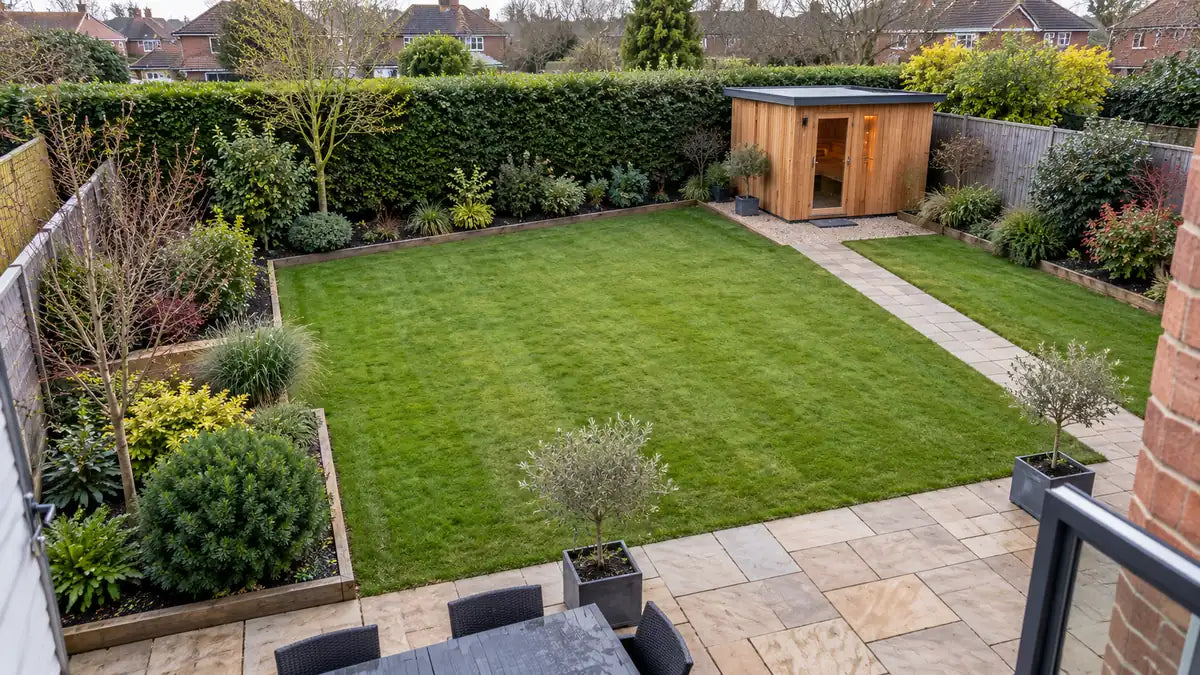
Planning permission
In England, garden saunas generally fall within the category of outbuildings. Many can be built under permitted development, but the conditions matter.
The rule that catches people most often is the two-metre boundary condition. Where an outbuilding is within two metres of a boundary, its maximum overall height is 2.5 metres.
This is the check where the product page earns its keep. Several cabins in the range state an overall height: the Cocoon 130 and the France Sauna Gaïa Urban at 2 metres, the Holl's Hestia 160 at 2.2 metres, the Onyxia Barrel at 2.26 metres. All of those clear the 2.5 metre limit, which means the boundary condition is a question you can settle from the page rather than a risk you carry into the order.
Other permitted-development conditions cover matters including eaves height, overall building height, how much land around the original house can be covered, position relative to the principal elevation, listed buildings and designated land.
The rules differ in Wales, Scotland and Northern Ireland.
Read Tarnfell's planning permission guide before ordering, and check your circumstances with the relevant local authority where necessary.
The base matters more than it looks
A sauna needs a suitable base for the particular model.
That generally means a level, load-bearing and well-drained foundation, but the precise requirement depends on the construction. The Harvia Kuusi, for example, has a specific foundation and anchoring requirement, and that is not what a flat-bottomed cabin asks of the ground.
Weight is the other half of it, and it varies more than the footprint suggests: the Hestia 160 is given as 649kg and the Kaski 180 Panorama as 510kg, both of which have to arrive on a base that will not settle unevenly under them.
Do not assume that one base specification applies to every sauna. Check the base requirement published on the page of the model you are actually considering.
Our guide to what base a garden sauna needs goes through the options, and what a raised base does to the height you measure for planning.
And think about drainage and access at the same time. The base has to be finished before the cabin arrives, and how a garden sauna is delivered sets out what the delivery day asks of your route.
Plan your space before you commit. It asks about the number of users, frequency of use, electrical supply, access width, base and smoke-control area because those questions can change the recommendation.
5. What will it cost to buy and run?
Prices and availability change, so use the live outdoor sauna collection for the current position rather than treating a buying-guide table as a permanent catalogue.
On 13 October 2026 the outdoor range spans roughly £3,495 to £10,995 across barrels and rectangular cabins, with capacities from two to six people and different construction, heater and delivery arrangements on each model.
Delivery to mainland Britain is included in every Tarnfell price. Do not compare the headline sauna price alone, though. Depending on the model, you may also need to account for:
- base preparation;
- electrical installation;
- installation or assembly;
- access requirements;
- and additional equipment required by the heating system.
Then there is what the cabin asks of you once it is standing there, which is less than most buyers expect but is not nothing. Our guide to how much maintenance an outdoor sauna needs sets out the jobs that actually matter, including the annual one Harvia says can break an electric heater's elements if it is skipped.
What does an outdoor sauna cost to run?
Running cost is more complicated than multiplying the heater's kW rating by your electricity price.
A thermostatically controlled electric heater does not necessarily draw its full rated power throughout an entire session.
Harvia gives an example of approximately 7 to 9kWh for a two-hour session using a 6kW family sauna, while actual consumption varies with construction, starting temperature, outdoor conditions, target temperature, glazing and usage.
At the Ofgem electricity price-cap rate for 1 October to 31 December 2026, 26.32p per kWh, that works out at roughly £1.84 to £2.37 per two-hour session.
At three sessions a week, that is approximately £287 to £370 per year.
Our guide to what a sauna costs to run in the UK shows that arithmetic in full, including what the October 2026 removal of VAT on household electricity did to the figure and what Harvia publishes about bringing annual consumption down.
Those are illustrations, not promises.
Actual consumption depends on:
- cabin construction;
- insulation;
- glazing;
- outside temperature;
- starting temperature;
- target temperature;
- heater sizing;
- session length; and
- how often the door is opened.
So do not look at 9kW and assume it will cost exactly 50% more to run than 6kW. The real picture is more complicated.
The five decisions, in order
- Format: barrel or rectangular cabin?
- Size: how many people will actually use it, and what internal space do you want?
- Heating: electric or wood-fired, and what does that require from the property?
- Base and access: can the sauna physically reach the garden, and can the site provide the right base?
- Siting: will the proposed position work under the relevant planning and access requirements?
Only after those five decisions should you worry about colours, lighting and finishes.
One decision sits before all five, and it is worth confirming you have already made it. An infrared cabin is a different appliance from a traditional sauna, not a cheaper version of one, and it runs at roughly half the temperature with no stones and no steam. If you have not settled that question, settle it before you go any further.
Three measurements to take before you buy
1. The available footprint
Measure the actual area where the sauna will stand, then check the manufacturer's external dimensions.
2. The route
Measure the narrowest point from where the delivery vehicle can stop to the proposed position.
Do not just measure the garden gate. Check gates, walls, steps, corners, overhead obstructions, slopes and the final carrying route.
3. The boundary distance
Measure from the proposed sauna position to the nearest boundary, then check the sauna's overall height.
The bottom line
Buying an outdoor sauna is not really a choice between attractive timber buildings.
It is a decision about room geometry, heating, construction, electricity, access, planning and ongoing ownership.
Get those decisions right and the product comparison becomes much easier.
Get them wrong and the most attractive sauna on the website can be the wrong sauna for your garden.
Start with the measurements. Then choose the format. Then size the room. Then choose the heating system. Then check the site.
Buy once. Choose well.
Further reading
- Infrared or traditional sauna: which should you buy?
- Barrel or cabin: which garden sauna shape should you buy?
- Which outdoor sauna should you buy? The seventeen compared
- What is the best timber for a sauna?
- What electrical supply does a garden sauna need?
- What base does a garden sauna need?
- How is a garden sauna delivered?
- How is a garden sauna installed, and who does what?
- What size sauna heater do I need?
- How much does a sauna cost to run in the UK?
- How much maintenance does an outdoor sauna need?
- Does a sauna need ventilation?
- Wood fired or electric: an honest comparison
- Do you need planning permission for a garden sauna?
- Indoor or outdoor sauna: which should you buy? Take this one first if the garden is not yet settled.
- How much space does an indoor sauna need? If the garden is not the answer, this is the indoor version of decision 4.
- What a British winter actually does to a garden sauna
- Plan your space
- Explore the outdoor sauna range


