
Do you need planning permission for a garden sauna?
Most garden saunas in England fall under permitted development, so no application is needed. The rule that catches people is the two metre boundary limit. The full rules, sourced and dated.

The short version: in England, most garden saunas can be installed without a planning application, because garden buildings fall under permitted development. The condition that most often catches people is height near a fence: within two metres of any boundary, the whole building must stay under 2.5 metres. Wood fired saunas then carry a separate set of rules that have nothing to do with planning, and electric ones swap the flue for the fuse board. All of it is below, with the sources linked.
The permitted development limits that matter
Garden buildings, which is what a sauna cabin is in planning terms, are permitted development in England provided they stay inside these limits, taken from the Planning Portal's guidance on outbuildings:
| Limit | The rule |
|---|---|
| Eaves height | Maximum 2.5 metres |
| Overall height | Maximum 4 metres with a dual pitched roof, 3 metres for any other roof |
| Within 2 metres of a boundary | Maximum overall height 2.5 metres |
| Garden coverage | No more than half the land around the original house may be covered by additions or other buildings |
| Position | Nothing forward of the principal elevation of the house |
| Raised platforms | None over 0.3 metres high |
These rights attach to houses. If you live in a flat or maisonette, or you rent, the position is different and a conversation with the council or your landlord comes first.
The rule that actually catches people
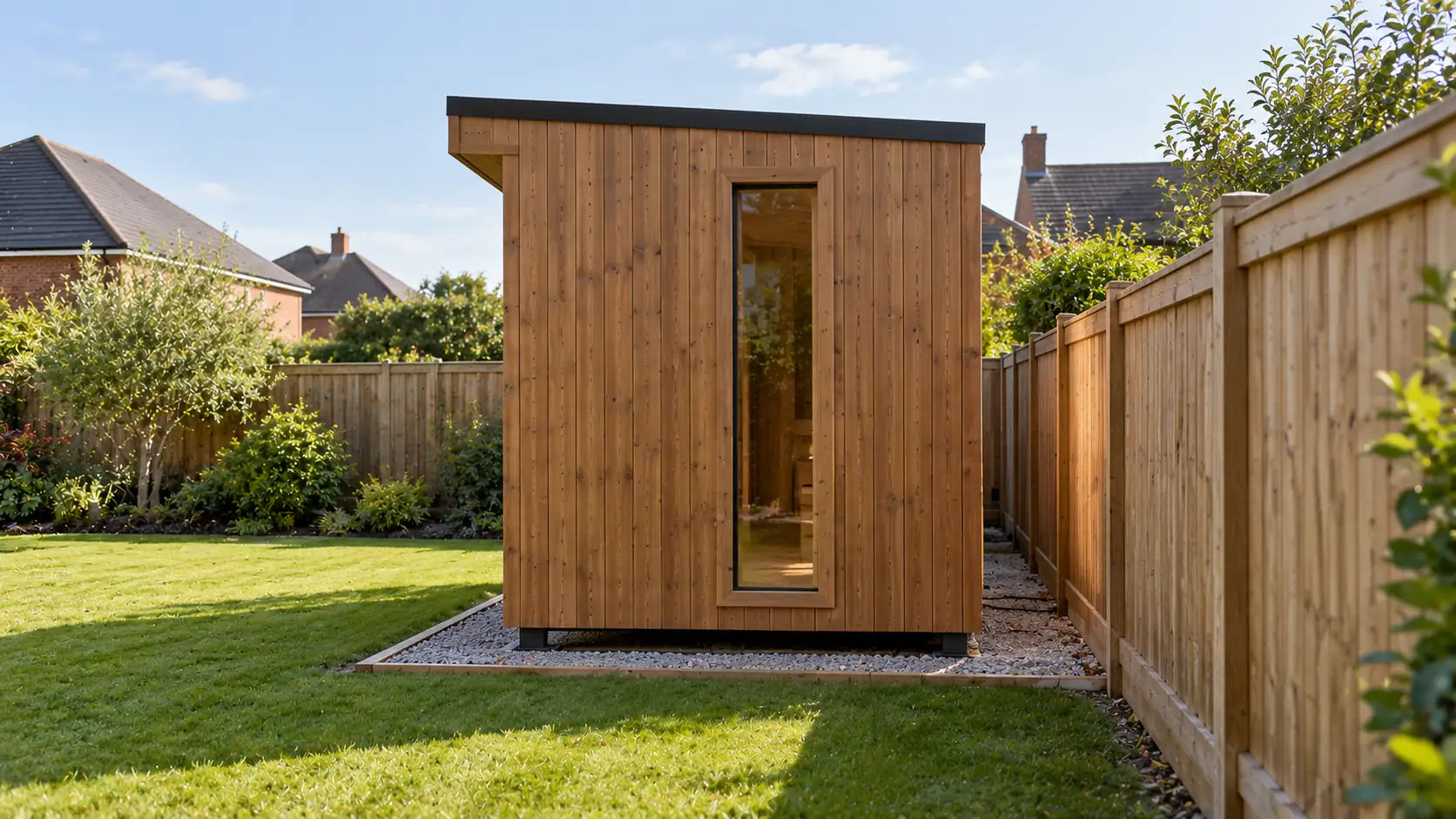
A garden sauna usually goes at the bottom of the garden, against a fence, because that is where the space is. That puts it within two metres of a boundary, where the limit is 2.5 metres overall, not the 3 or 4 metres allowed elsewhere in the garden.
Plenty of barrel saunas and apex-roofed cabins clear 2.5 metres comfortably. A cabin that is fine in the middle of the lawn can need a planning application two metres to the left. So before you fall for a particular model, do two measurements: the height of the building including its roof, and the distance from where you want it to the nearest boundary. Those two numbers decide whether your purchase is paperwork-free.
Roof shape is what usually decides it, so the check has to be done on the specific model. A curved barrel like the Harvia Kuusi 180 Panorama and a low cabin like the Holl's Cocoon 130 do not present the same height to that 2.5 metre limit, and the difference can decide where either one is allowed to stand in the same garden.
The useful news is that several cabins in the range now publish an overall height on the product page, and the figures land below the boundary limit rather than near it. The Cocoon 130 and the France Sauna Gaïa Urban are both given as 2 metres tall, and the Holl's Hestia 160 as 2.2 metres. On a model whose height is not stated on its page, ask us before you order and we will confirm it for you in writing.
Height is measured from the ground next to the building, so a base or frame that raises the cabin plausibly counts towards it. Our guide to what base a garden sauna needs shows how much headroom each published height leaves under the 2.5 metre limit.
When you do need permission
- Listed buildings: any outbuilding within the curtilage of a listed building needs planning permission.
- Designated land (conservation areas, National Parks, the Broads, Areas of Outstanding Natural Beauty, World Heritage Sites): a building at the side of the house needs permission, and more than 20 metres from the house the outbuilding is limited to 10 square metres.
- Over the height limits, or forward of the front of the house, or past half the garden covered: permission needed.
This article describes the rules for England. Wales, Scotland and Northern Ireland have their own versions, and they differ in the details, so check with your local authority if you are outside England.
Wood fired saunas carry rules that are not planning at all
Passing permitted development is not the end of the paperwork for a stove and flue. Four separate regimes apply, and retailers rarely mention them:
- Smoke control areas. Much of urban Britain is a smoke control area, and the government's own guidance says a chimney on the roof of a building is covered, giving a summerhouse as its example. Burning unauthorised fuel or emitting chimney smoke can bring penalties of up to £300 for smoke and up to £1,000 for buying unauthorised fuel, unless the appliance is on the Defra exempt list. Check your council's smoke control map before ordering a wood fired sauna, not after.
- Carbon monoxide alarm. Installing a fixed solid fuel appliance requires a CO alarm to BS EN 50291 in the same room, positioned on the ceiling at least 300 mm from any wall, or high on a wall, and between 1 and 3 metres horizontally from the appliance. Approved Document J, in force since 1 October 2022.
- Fuel. Wood sold in England in volumes under two cubic metres must be certified to 20 per cent moisture or less and carry the Ready to Burn mark. That is law, not advice.
- Sweeping. HETAS guidance is to sweep at least twice a year when burning wood, timed around the heating season.
Electric saunas swap the flue for the fuse board
An electric sauna avoids all of the solid fuel rules above. It does not avoid paperwork, and it is worth being straight about that.
The arithmetic first: a 6 kW heater at 230 volts draws about 26 amps, which is far beyond what a standard 13 amp plug and socket can carry. So a typical sauna heater needs its own dedicated, hard-wired circuit. Across the live outdoor range that circuit runs from 20 amps on the smallest 4.5 kW cabin to 40 amps on the 8 and 9 kW cabins, and each product page states the figure for that model.
Under Approved Document P, a room containing a sauna heater is a special location, which means not just new circuits but any addition or alteration to existing circuits in that room is notifiable building work. In practice: a registered electrician does the work and issues an Electrical Installation Certificate or Minor Works Certificate plus a Building Regulations Compliance Certificate. Electrical Safety First puts the consequence plainly: homeowners must be able to prove electrical work meets Part P or they are committing a criminal offence, and councils can require non-compliant work to be altered or removed.
So neither route is form-free. The wood fired route brings the smoke and fuel regime; the electric route brings a notifiable electrical installation. Which one suits you is a different question, and our guide to wood fired versus electric takes it on properly.
Before you order
- Measure the overall height of the model you want, including the roof, and the distance from its intended spot to the nearest boundary. Two metres and 2.5 metres are the numbers to hold in your head.
- Check whether you are in a smoke control area on your council's website if you are considering wood fired.
- If your house is listed or you are on designated land, talk to the planning department before ordering anything.
- Budget for a registered electrician if the sauna is electric, and ask for the certificates by name.
- Think about how the building arrives as well as where it stands: our piece on access, ground and the day the lorry arrives covers the part of the purchase most people discover too late.
If you are still at the stage of working out what fits your garden at all, start with our outdoor sauna buying guide, check the footprint against Plan your space, and the cabins themselves are under outdoor saunas.
Sources
- Permitted development limits for outbuildings: Planning Portal. planningportal.co.uk
- Smoke control area rules and penalties: GOV.UK. gov.uk/smoke-control-area-rules, exempt appliances at smokecontrol.defra.gov.uk
- Carbon monoxide alarms: Approved Document J, 2010 edition incorporating the 2022 amendments. gov.uk
- Wood fuel moisture and Ready to Burn: GOV.UK. gov.uk
- Chimney sweeping frequency: HETAS. hetas.co.uk
- Notifiable electrical work and special locations: Approved Document P, 2013 edition. gov.uk
- Part P certificates and consequences: Electrical Safety First. electricalsafetyfirst.org.uk


